


Stéphane Regnault
About
Regnault’s holdings constitute 4 hectares of old vine and densely planted Chardonnay in three lieu-dits: Chemin de Flavigny in Oger, Moulin on the border between Oger and Le Mesnil, and Hautes-Mottes in Le Mesnil. Stéphane has farmed these organically since 2014, a decision he remains committed to, even after the disastrous 2024 vintage which saw many producers turning towards systematics in a last-ditch effort to save their fruit from the rain. While he sympathizes, Regnault told us that he wasn’t able to compromise on his values. “It’s okay,” he says about his losses. “You try to make something and you don’t really stop.” Later on, he refers to the hardest vintage of his life as a “grower year,” which is the kind of euphemism that truly speaks to an all-encompassing vision.
It’s in the cellar, especially, where this vision becomes clearest. Stephane favors a gentle bladder press, and keeps and vinifies separately the tails. These he uses to break in new barrels, and ultimately, toadjust acid levels on the final wines. He exposes the juice to oxygen to develop resilience and only moves the wines using gravity to avoid too much jostling. Sulfur levels are low – just 2 grams at crush and a similar amount post-disgorgement – not because of any ideological reasons, but because, frankly Stéphane hasn’t found much need, what with all the aging and the high acid chalk soil. Chromatique, his youngest wine, is a true fingerprint of the domaine, drawn from all three lieu-dits, raised in both wood and steel, and with a hefty lashing of a perpetual reserve. Year in and out, we find it to be one of our favorite assemblage Champagnes, and a fantastic introduction to Regnault’s precise and measured winemaking.
The three parcelaire wines, Dorien, Lydien and Mixolydien (an accomplished jazz musician, Stéphane names all his wines after musical modalities), are all made the exact same way - each vintage is raised in old wood and completes malolactic. From there, the vintage is blended with a site specific perpetual reserve, which Stephane says is “a history of Champagne.” This blending is where Stephane tells us the winemaker’s hand is most visible, where the wine becomes true Champagne and not “Burgundy with bubbles.” In the cellar, Regnault’s love of the reserve is made clear – the current vintage barrels are labelled by parcel, but it’s the reserve that is given the cuvee name. This additive nature of the winemaking is reflected in Regnault’s naming convention, where each release is the sum of every vintage contained within - ie. Lydien 80 has vintages 14,15,16,17 and 18 in the bottle. Despite their identical techniques, each of the three parcelaire wines has a unique identity. Lydien is juicy and rounded,” almost like a balloon!” Mixolydien, in contrast, is more complicated with well integrated minerality and depth. Dorien, in general, is the most linear of the three, a wine that Stéphane compares to a tunnel - straight and deep. All three, we find, are intensely moving and singular wines – certainly ready to wow right now, but with enough energy and power to age and further develop.
Despite his growing fame, Stéphane remains locked in on his work and fixated on iterating better and better. Although there’s fantastic vineyards available nearby, he’s hesitant to add another single parcel champagne because he’s not sure if he could understand the plot fully, and also, of course, the sheer time commitment his methodology demands, telling us: “More important than making more wine is making better wine.” We’re happy to announce that we’ve no doubt Stephane will continue to do so, and are beyond proud to be able to offer his work to you all.

Products

Champagne 'Lydien' Blanc de Blancs Grand Cru Extra Brut
Certified Organic. 100% Chardonnay. The vines are between 35-50 years old and sit on light chalky soils. Hand harvested. Fermentation and aging ⅓ in used barrels, and ⅔ in stainless steel tanks. Malolactic fermentation is neither encouraged or blocked - generally occurs in the barrels, but not in the tanks. Bottling in June. Disgorged after a minimum of 30 months. Approx annual production: 150-180 cs.
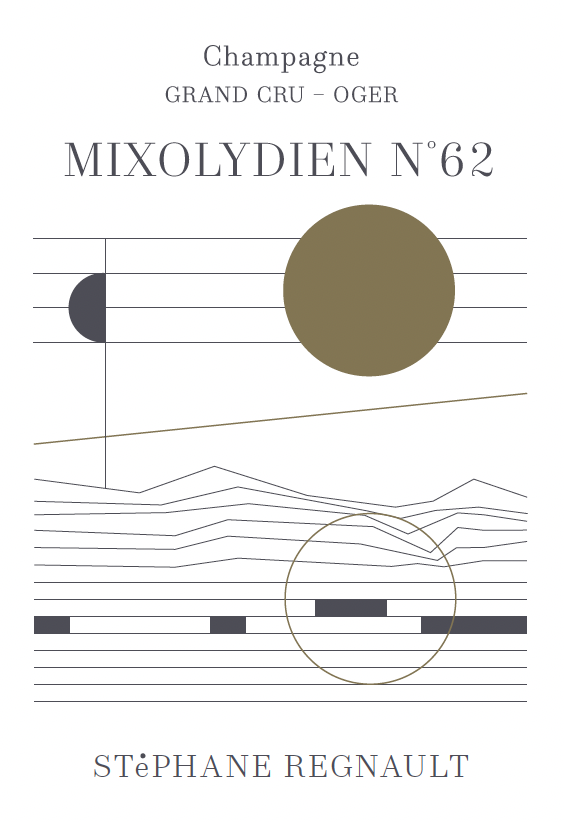
Champagne 'MixoLydien' Blanc de Blancs Grand Cru Extra Brut
Certified Organic. 100% Chardonnay. Base vintage 2016, with reserve ’15 and ’14 blended. (65% 2016, 35% reserve wine). Native fermentation, with 2016 fermenting entirely in barrel. Completes malolactic. Aged on lees four years and ten months. Dosage 1 g/L. Disgorged May 2022. Taken from the single-vineyard Moulin (Grand Cru), planted in the 1970s. Moulin’s characteristics are: eastern exposure, thin topsoil supported by grass plantings, transitional horizon rich in chalk and fairly deep, subsoil of soft, fractured chalk. Work done in the vineyard taking lunar cycle into account; plant decoction used for vineyard treatments.

Champagne 'Dorien' Blanc de Blancs Grand Cru Extra Brut
Certified Organic. 100% Chardonnay. Taken from the single vineyard Hautes-Mottes, which lies on the far side of the railway on the plain south of Le Mesnil. Hautes-Mottes means ‘high mound’ and refers to the unusual veins of chalk that extend into the plain. Southern exposition. ½ of the vineyard planted 1950s; ½ planted 1980s. Work done in the vineyard taking lunar cycle into account; plant decoction used for vineyard treatments. Base vintage 2018, with reserve wine 2014-2017 blended. (85% 2018 wine, with 15% reserve wine taken from a perpetual solera created in 2014 exclusively with wine from the Hautes-Mottes parcel from which Dorien is made). Native fermentation, with 2018 barrel-fermented. Completes malolactic. Dosage 1 g/l; disgorged March 2024.

Champagne 'Chromatique' Blanc de Blancs Grand Cru Extra Brut
Certified Organic. 100% Chardonnay. The ‘Chromatique’ cuvée is taken from bits and pieces of all of the sites with which Regnault works, to give a ‘chromatic’ representation of the terroir—one that, as in the musical term, ‘uses all the notes.’ Included are vines from Le Mesnil, toward the bottoms of very chalky slopes, and some from Oger, where the soils are richer. Base vintage 2020: 30% of the cuvée was fermented and raised in wood; 30% in steel; 40% is reserve wine (taken from vintages 2014 - 2019).

